Between space and silence: the sculptural language of Archipenko
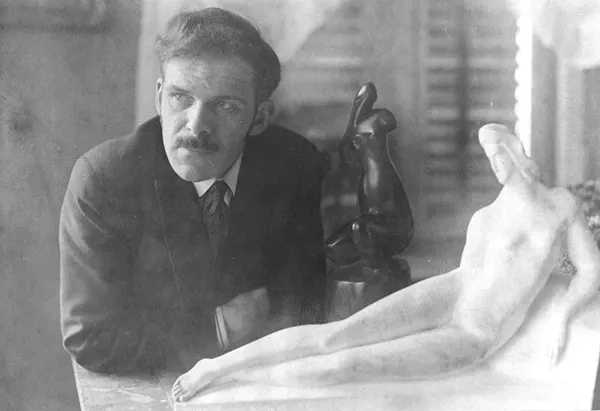
Alexander Archipenko, a Ukrainian pioneer of the avant-garde who changed the form of the world. The name of Alexander Archipenko is one of those that adorn the world history of 20th-century art. He was not only a talented sculptor and painter but a true revolutionary in the world of form, space and plasticity. A native of Kyiv, he went from a student at an art school to one of the most influential representatives of the European avant-garde. His works were exhibited alongside those of Picasso, Braque and Léger, and art historians called him “the sculptor of a new vision”.
From Kyiv to Paris: the beginning of the journey
Alexander Archipenko was born on 30 May 1887 in Kyiv. His art education began at the Kyiv Art School, but within a few years he moved to Paris, then the centre of artistic revolutions. At the famous Académie Julian and in the atmosphere of Montparnasse, Archipenko encountered the latest movements, Cubism, Futurism and Expressionism, and began to create something entirely new.
Innovations ahead of their time
Archipenko was the first to apply the principles of Cubism to sculpture. He did not simply cut form; he opened up its space. Where others tried to reproduce the human body as a solid volume, Archipenko boldly introduced voids: openings that spoke as expressively as the material.
His technique of “sculpto-painting”, combining three-dimensional sculpture with plane and colour, was especially innovative. It took sculpture beyond traditional imagination, giving it dynamism and symbolism.
America, recognition and teaching
In 1923 Archipenko emigrated to the USA, where he continued his creative work and opened several schools in New York, Los Angeles and Chicago. Here he became not only an artist but also a mentor for a new generation of sculptors. His works were shown at the Venice Biennale and in museums in Paris, New York and Berlin.
He also patented several devices, including an electric kinetic display that anticipated the development of digital art.
A Ukrainian who remained Ukrainian
Despite living abroad, Archipenko did not forget his roots. In letters and speeches he mentioned Ukraine, admired folk sculpture and icons, and often turned to the forms of Cossack Baroque and the Byzantine tradition.
A living legacy
Alexander Archipenko died in New York on 25 February 1964. Streets in Kyiv, Lviv and Chicago are named after him. His works adorn the collections of leading museums, from the Louvre to MoMA. But the most valuable is the mark he left on art: the courage to think about space, to see form in emptiness, to break traditions and create something new. His works are now kept at the National Art Museum of Ukraine.
Archipenko is not just a sculptor. He is an architect of a new vision, a poet of form, a Ukrainian whose work changed the world.