Ukrainian rushnyky: traditions and symbolism
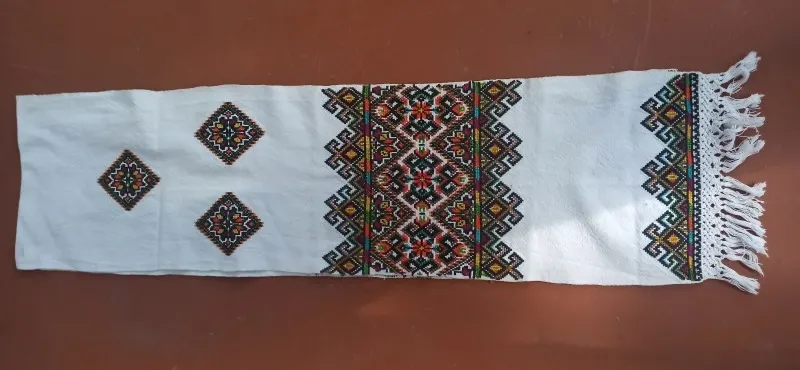
Ukrainian rushnyky (ritual embroidered towels) are one of the deepest symbols of Ukrainian culture, combining the traditions, worldview and spiritual heritage of our people. They accompanied a person from birth to their final journey and were an amulet, a sign of blessing, an expression of skill and of the language of ornament that for centuries was understood without words. Each region of Ukraine developed its own techniques, colour palette and motifs, which formed unique local styles and together created the colourful mosaic of Ukrainian textile art.
Today, turning to the tradition of the rushnyk, we not only open a page of the past but also feel a living connection with the roots of our culture. After all, a rushnyk is always about memory, identity and the continuity of Ukrainian history.
Traditions
The Ukrainian embroidered rushnyk holds a special place in folk culture, as it accompanies a person throughout life, from birth and christening to marriage and the final journey. Behind the outward beauty of the rushnyk lies deep knowledge about life, family and a person's connection with their ancestors. That is why the rushnyk was not just a decoration for the home but a powerful amulet able to protect, bless and bring prosperity.
In everyday life rushnyky adorned icons and homes, and bread and salt were presented to dear guests on them. In some regions, particularly in the Middle Dnipro area, the rushnyk was used as a festive belt, a protective part of clothing that strengthened the effect of a ritual.
When a baby was born, the rushnyk was one of the main protective attributes. Specially embroidered ornaments created an amulet for mother and child, guarding against illness and the evil eye. The rushnyk was used together with other symbolic objects: a sheepskin coat, a fur hat, clean water. It was believed that a properly embroidered birth rushnyk paved the way to a happy destiny for the child.
The wedding tradition shows the role of the rushnyk most fully, as it accompanies all the key rituals:
- Matchmaking, often simply called “rushnyky”. If a girl agreed to marry, she tied rushnyky on the matchmakers, and bread for the honoured guests was served on embroidered cloth.
- Betrothal (“rushnyky”): the elder bound the hands of the young couple with a rushnyk, symbolising the union of two families. Then the rushnyk was untied, and the bride presented the matchmakers with embroidered cloths.
- The korovai ritual: the wedding loaf was covered with a rushnyk on which the newlyweds and their relatives laid their hands.
- Parental blessing: parents blessed their children on a rushnyk, which was to become a happy path for the new family.
Wedding rushnyky were embroidered with special love and attention to symbols, as every pattern carried a blessing for harmony, prosperity and the continuation of the family.
At a funeral the rushnyk helped see a person off on their final journey. Clean white rushnyky were hung in the windows as a sign of memory and respect. A rushnyk might decorate the coffin or be used in ritual acts, as it symbolised a bright passage and the blessing of the family.
When a son set off on a long journey, his mother gave him a rushnyk as a strong amulet. Into it she put a prayer, love and wishes for a happy return. This custom is reflected in many songs and legends and is one of the most touching expressions of maternal care.
Thus the rushnyk remained not just a decorative object but a spiritual companion of Ukrainians: a sign of memory, love and an invisible force that unites generations.
The symbolism of Ukrainian rushnyky
The symbolism of the rushnyk is a complete system of ancient ideas about life, nature and humankind, conveyed through ornaments. Each sign had its own meaning and was used as an amulet meant to protect the family, give strength or bless for a good destiny.
Among the most common motifs are the Sun and Water, the two foundations of life. The Sun, depicted as an eight-pointed rosette, embodied paternal strength and creative energy. Water, shown by wavy or “snake” lines, symbolised maternal care and the beginning of life.
The image of the Mother, an eight-pointed star in a garland, emphasised the importance of female strength and the continuation of the family.
Hop leaves symbolised youth and love, so they were often embroidered on wedding rushnyky.
The rose embodied beauty, solar energy and the continuity of the life cycle.
The guelder rose (kalyna) was an amulet for the home and family, a symbol of health and a strong family.
The oak meant male strength, endurance and protection.
The poppy was used as one of the most powerful amulets against evil and the evil eye.
The image of a vase of flowers or of Berehynia symbolised life-giving energy and the protective power of woman.
Grapes were associated with prosperity and the continuation of the family, and the lily with purity, love and fidelity.
Geometric signs were also important: stars symbolised the harmony of the universe, and the rhombus the power of the Earth, fertility and protection.
Traditions associated with the rushnyk remain alive today. It continues to be an attribute of family and community rituals and a symbol of hospitality, prosperity, love and protection. Despite the changing times, the rushnyk retains its power as a sign of the unbreakable bond between past and present, between a person and their roots.
By studying the rushnyk, we touch the very essence of Ukrainian culture: its sensitivity to beauty, deep spirituality, reverence for family and respect for tradition. You can explore the collection of rushnyky held in Ukrainian museums on the Register of the Museum Fund of Ukraine portal. The rushnyk is and remains that invisible yet strong cloth that unites generations and continues the history of our people.
Cover image: an embroidered rushnyk from the collection of the Ustynivka Museum of History.