From thread to pattern: the art of weaving and embroidery
The art of weaving and embroidery is one of the oldest languages of human culture, in which every knot, stitch and ornament preserves the memory of generations. It was born of the practical need to make clothing and household items, but very quickly became a means of self-expression, symbolic encoding of the world and passing on family stories.In the Ukrainian tradition these crafts became special: they combined manual skill, the poetics of images and a philosophy of signs that for centuries accompanied a person from birth to the most important events of life.
Today interest in weaving and embroidery is only growing: ancient techniques are returning in contemporary design, and ornaments that once adorned shirts or carpets are becoming part of a new cultural sound. This article is about how a pattern is born from ordinary thread, and why this magic does not lose its power even in the 21st century.
The origins of weaving
Weaving is one of the oldest forms of Ukrainian folk art, dating back to the Neolithic. Archaeological finds show the existence of the first spindles, spindle whorls, loom weights and even fabric imprints on pottery. At first people wove wool, later flax and hemp, which became the basis of traditional production.
In the Scythian period weaving reached a high level, and in the time of Kyivan Rus' the horizontal loom appeared, which greatly speeded up the work. Spinning and weaving were collective activities, and tools were marked with names and special signs. In folk culture the craft had sacred significance, and the goddess Mokosh was considered the patroness of weavers.
For a long time weaving remained a domestic occupation, but from the 9th–10th centuries it became a separate craft.Weavers settled near trade routes and paid taxes in goods. In the 14th–16th centuries guilds appeared in towns, and in the 17th–19th centuries manufactories producing linen, woollen cloth and silk. With the appearance of factories in the 19th century traditional production changed, although weaving survived in villages until the 20th century.
Weaving centres and techniques
The main weaving techniques are plain weave, twill, overshot, tapestry and pile weaving. They were used to make clothing (shirts, belts, plakhtas, zapaskas) as well as interior items: rushnyky, carpets, tablecloths and bedspreads. Utilitarian fabrics were used in the household, for example for sacks.
Famous weaving centres of Ukraine include Krolevets, Bohuslav, Dihtiari, Lviv, Kosiv, Kolomyia and Reshetylivka. Each has its own ornaments, colour schemes and techniques. Despite the decline of traditional weaving in the mid-20th century, today it is being revived by folk enterprises and masters, especially in the Carpathians and Polissia. Weaving is returning as an element of cultural identity and as contemporary decorative art.
Ukrainian embroidery
As for embroidery, as early as the time of the Cimmerians, Scythians and Sarmatians, clothing made of linen and leather was decorated with geometric patterns: meanders, swastikas, waves. This is attested by Herodotus's descriptions and archaeological finds on gold jewellery.
Particularly valuable is a find from the excavations of the Sokolova Mohyla burial mound: fragments of Sarmatian silk fabric with gold embroidery (1st century BC). Executed in the couching technique, it attests to the sacred symbolism of ornaments and the great skill of ancient needlewomen.
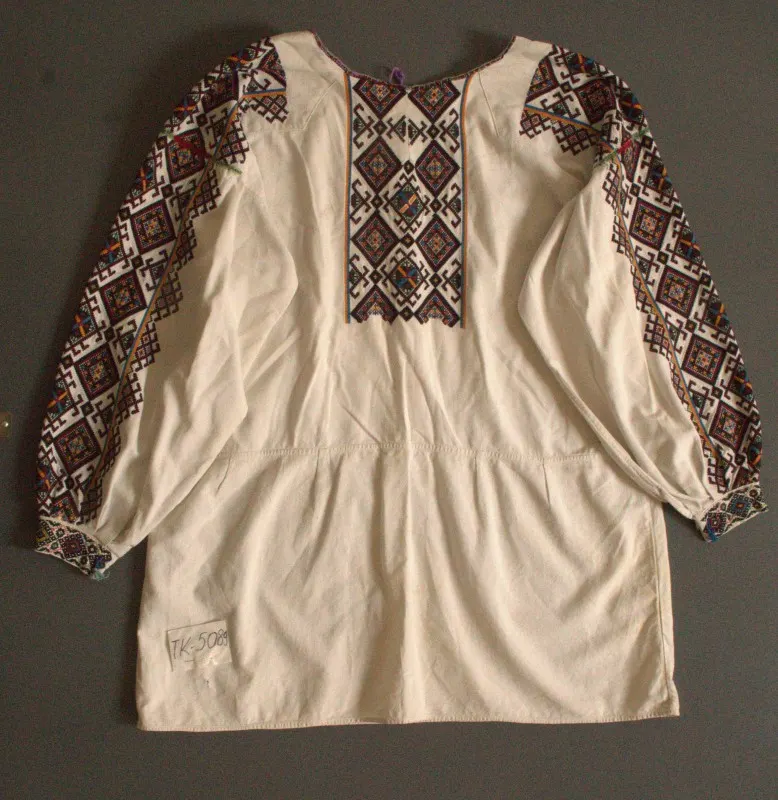
Artefacts such as the Martynivka hoard and images on stone statues confirm the antiquity of the tradition of embroidered clothing. In Kyivan Rus' monastery schools developed where silk, gold and silver embroidery was mastered. The oldest techniques are straight satin stitch, retiaz, nyzynka, chain stitch and cross stitch.
In the 18th century beads and bugle beads became increasingly popular, especially in the Carpathians and Halychyna. This is where herdany, zgardy and other beaded ornaments come from. In the 19th century the vyshyvanka became popular among townspeople and the intelligentsia. In the 20th century it became a symbol of national resilience and memory. Machine embroidery spread, making ornaments mass-produced.
Ornament and diversity
Geometric patterns (rhombuses, zigzags, spirals) carried symbols of fertility and protection. These are the most enduring motifs, preserved in different regions of Ukraine.
Each region developed its own techniques: nyzynka in Podillia, white-on-white in Poltava region, red-and-black motifs in Kyiv region, beaded ornaments and herdany in the Carpathians. In total, about 150 techniques are known in Ukraine. The oldest and most widespread are straight satin stitch, retiaz (common in Western Ukraine), cross stitch, chain stitch, nyzynka and double-sided satin stitch.
After independence, especially since the Orange Revolution, the vyshyvanka has become a symbol of national identity. Contemporary masters combine traditional techniques with new materials: organza, mesh and designer fabrics. Embroidery is widely used in fashion, product design and art.
The significance of weaving and embroidery for Ukraine
Weaving and embroidery in Ukraine are not just techniques for decorating fabric but a complete system of cultural codes combining ancient symbols, regional traditions and the skill of many generations. Both crafts have gone from household necessity to an artistic phenomenon that shapes the visual identity of the people. The patterns hold history, the techniques continuity, and the objects a living connection between past and present.
Today weaving and embroidery continue to develop, remaining one of the most expressive symbols of Ukrainian culture and its creative power. The portal brings together the most valuable traditions and techniques of weaving preserved and passed on to this day.
Cover image: an embroidered shirt from the collection of the Lviv Historical Museum.